The Science Behind the Shield: Exploring the Chemical Composition of Ceramic Coating
When you roll into 1469 Supercenter in Fort Wayne, you're not just getting a car wash; you're investing in advanced chemistry. Ceramic coating isn't some magic potion or glorified wax. It's a carefully engineered liquid polymer that transforms into a semi-permanent molecular shield on your vehicle's surface. But what exactly goes into this protection, and why does it outperform traditional detailing products by such a wide margin?
As Fort Wayne's premier detailing experts and an IDA Certified, Onyx Authorized Installer, we believe our customers deserve to understand the science behind the shine. Let's break down the chemical composition of ceramic coating and explore what makes professional-grade protection fundamentally different from what you'll find on a retail shelf.
The Big Three: Understanding Ceramic Coating Chemistry
At its core, every quality ceramic coating is built on three foundational components: Silicon Dioxide (SiO2), Titanium Dioxide (TiO2), and Polysiloxanes. These aren't just fancy ingredients listed on a label; they're the molecular backbone of protection that can last years instead of months.
Think of it this way: if traditional wax is a raincoat, ceramic coating is a architectural-grade sealant. The difference lies entirely in the chemistry.
The Hardness Backbone: Silicon Dioxide (SiO2)
Silicon dioxide is the quartz foundation of ceramic coating. Derived from one of nature's hardest minerals, SiO2 creates a three-dimensional crystalline structure on your vehicle's clear coat when properly cured. This isn't a coating that sits on top of your paint; it chemically bonds at the molecular level.
The Hardness Hierarchy
You've probably seen hardness ratings like "9H" thrown around in marketing materials. Here's what that actually means: the pencil hardness scale measures a coating's resistance to scratching, with 9H representing exceptional durability. But at 1469 Supercenter, we exclusively use Onyx coatings with certified 10H hardness, the industry's highest standard.
This difference matters in real-world conditions. That 10H rating translates to superior resistance against:
- Swirl marks from improper washing techniques
- Bird droppings and their acidic etching
- Industrial fallout common near Fort Wayne's manufacturing zones
- Minor abrasions from road debris between here and Decatur or Warsaw
The concentration of SiO2 determines this protective capability. Consumer-grade spray coatings typically contain 10-30% silicon dioxide. Professional formulations like those we apply at 1469 Supercenter? We're talking 80-85% high-purity SiO2. That concentration gap isn't just incremental; it's the difference between temporary protection and a permanent bond.
The Invisible Sunscreen: Titanium Dioxide (TiO2)
While SiO2 provides the structural armor, titanium dioxide serves as your paint's personal UV shield. If you've ever seen a vehicle's paint fade from vibrant red to chalky pink, you've witnessed UV radiation breaking down paint molecules. TiO2 prevents that degradation.
How It Works
Titanium dioxide particles, sized at the nanoscale (less than 100 nanometers), create an invisible barrier that reflects both UV-A and UV-B radiation. This is particularly crucial in the Midwest, where we experience dramatic seasonal swings, from intense summer sun to harsh winter conditions that compound UV exposure with reflective snow.
But TiO2 does more than just reflect light. It has a photocatalytic property that actually helps decompose organic pollutants on contact. Those tree sap deposits that plague vehicles parked along Fort Wayne's tree-lined streets? TiO2 helps break them down before they can etch into your clear coat.
The particle size matters tremendously. Larger TiO2 particles can create a hazy appearance, which is why cheaper coatings sometimes leave a cloudy film. Professional-grade formulations use exclusively nanoscale particles to maintain complete optical clarity while delivering maximum UV protection.
Flexibility & Flow: Polysiloxanes and the N1 Difference
Here's a counterintuitive truth: if a ceramic coating were nothing but hardness, it would crack. Vehicle panels expand and contract with temperature changes, sometimes dramatically in our Fort Wayne climate where we can see 70-degree temperature swings between seasons.
The Role of Polysiloxanes (PDMS)
Polysiloxanes, particularly Polydimethylsiloxane (PDMS), serve as the flexible binder in ceramic coatings. This is the "glue" that allows the coating to move microscopically with your vehicle's metal panels as they expand in summer heat and contract in winter cold.
PDMS delivers two critical benefits:
- Hydrophobic properties: Those mesmerizing water beads you see rolling off a ceramic-coated vehicle? That's polysiloxanes creating extreme water contact angles, often exceeding 110 degrees.
- Chemical resistance: Polysiloxanes create a barrier against acidic contaminants, from acid rain to the calcium chloride road treatments that coat Fort Wayne streets every winter.
N1 Smoothness Technology
At 1469 Supercenter, we highlight Onyx's N1 Technology, a specific chemical refinement in the polysiloxane chain that produces what we call "intensely smooth" surface characteristics. Run your hand across an N1-treated surface and you'll feel a level of slickness that defies description. That's molecular-level smoothness, where the coating has filled in microscopic imperfections invisible to the naked eye.
The Supporting Cast: Carrier Solvents and Nanoparticles
Beyond the main ingredients, carrier solvents play a crucial delivery role. These solvents keep the coating in liquid form during application, then evaporate during the "flash" process to leave behind only the protective solids.
Professional formulations use low-VOC (Volatile Organic Compound) carrier solvents, which are both safer for applicators and more stable during curing. This is one reason why DIY ceramic coating attempts often fail: home environments can't control the evaporation rate or environmental conditions the way our climate-controlled facility at 1469 Supercenter can.
Nanoparticles deserve special mention. These microscopic particles (often SiO2 at the nanoscale) physically fill the porous structure of your vehicle's clear coat. Automotive clear coat isn't actually smooth at the microscopic level; it's full of tiny valleys and peaks. Nanoparticles fill those valleys, creating a truly level surface that reflects light uniformly (that's where the mirror-like finish comes from) and prevents contaminants from gaining a foothold.
The Curing Process: From Liquid to Glass
Application is only half the story. The real magic happens during curing, when ceramic coating undergoes a chemical transformation from liquid polymer to a glass-like shell.
Hydrolysis and Cross-Linking
When ceramic coating is exposed to moisture in the air, a hydrolysis reaction begins. The siloxane molecules start forming cross-links with each other and with the hydroxyl groups on your vehicle's clear coat. This creates a covalent molecular bond, the strongest type of chemical connection.
This process requires precise environmental control:
- Humidity levels: Too low and the coating won't cure properly; too high and it cures too fast, potentially trapping imperfections
- Temperature: Ideal curing occurs between 60-80°F
- Flash times: The period between application and when cross-linking begins must be carefully managed
This is why professional application matters. At 1469 Supercenter, we control every variable in our application bay. We manage flash times down to the minute and monitor environmental conditions continuously. A consumer applying coating in their garage on a humid Fort Wayne summer evening? They're basically hoping for the best.
The full cure typically takes 24-72 hours, during which the coating should avoid water contact. Many customers don't realize that an incompletely cured coating can fail within months, even if it initially looks perfect.
Professional Grade vs. DIY: Why Chemistry Matters
Let's address the elephant in the room: you can buy "ceramic coating" at auto parts stores for $30. So why invest in professional application that costs significantly more?
The answer lies in the chemistry we've been discussing.
The Concentration Gap
| Feature | Consumer-Grade Spray | Professional Onyx (1469) |
|---|---|---|
| Main Ingredient | 10–30% SiO2 | 80%+ Pure SiO2 |
| Hardness Rating | 2H - 4H | Certified 10H |
| Expected Durability | 6 - 12 Months | Up to Lifetime (with maintenance) |
| Bonding Method | Surface Adhesion | Covalent Molecular Bond |
| UV Protection | Minimal to None | TiO2 Nanoparticles |
| Hydrophobic Performance | Moderate | Extreme (110°+ Contact Angle) |
That table tells the story: similar names, radically different chemistry.
Consumer products achieve their low price point by diluting active ingredients. They often skip TiO2 entirely, offer no real polysiloxane flexibility, and use lower-grade SiO2 at concentrations that simply can't create a durable bond. They're designed for surface adhesion, think of it like tape stuck to your paint. Professional coatings create molecular bonds; imagine welding at the atomic level.
Fort Wayne-Specific Protection Challenges
Understanding ceramic coating chemistry matters even more when you consider our local environment. Fort Wayne and surrounding areas (from Decatur to Warsaw) present specific challenges that demand professional-grade protection:
Road Salt and Calcium Chloride: Our winter road treatments are chemically aggressive. The high SiO2 concentration and polysiloxane barrier in professional coatings resist these corrosive compounds far better than consumer products.
Acid Rain: Midwest industrial activity contributes to acidic precipitation. TiO2's photocatalytic properties actively break down these acidic deposits before they etch paint.
Tree Sap and Organic Contaminants: Fort Wayne's tree-lined neighborhoods are beautiful but deposit sticky sap that can permanently bond to unprotected clear coat. The extreme hydrophobic properties of professional ceramic coating prevent this bonding.
Temperature Extremes: Our 100-degree summer days and sub-zero winters demand the thermal flexibility that only high-quality polysiloxanes provide.
The 1469 Supercenter Advantage
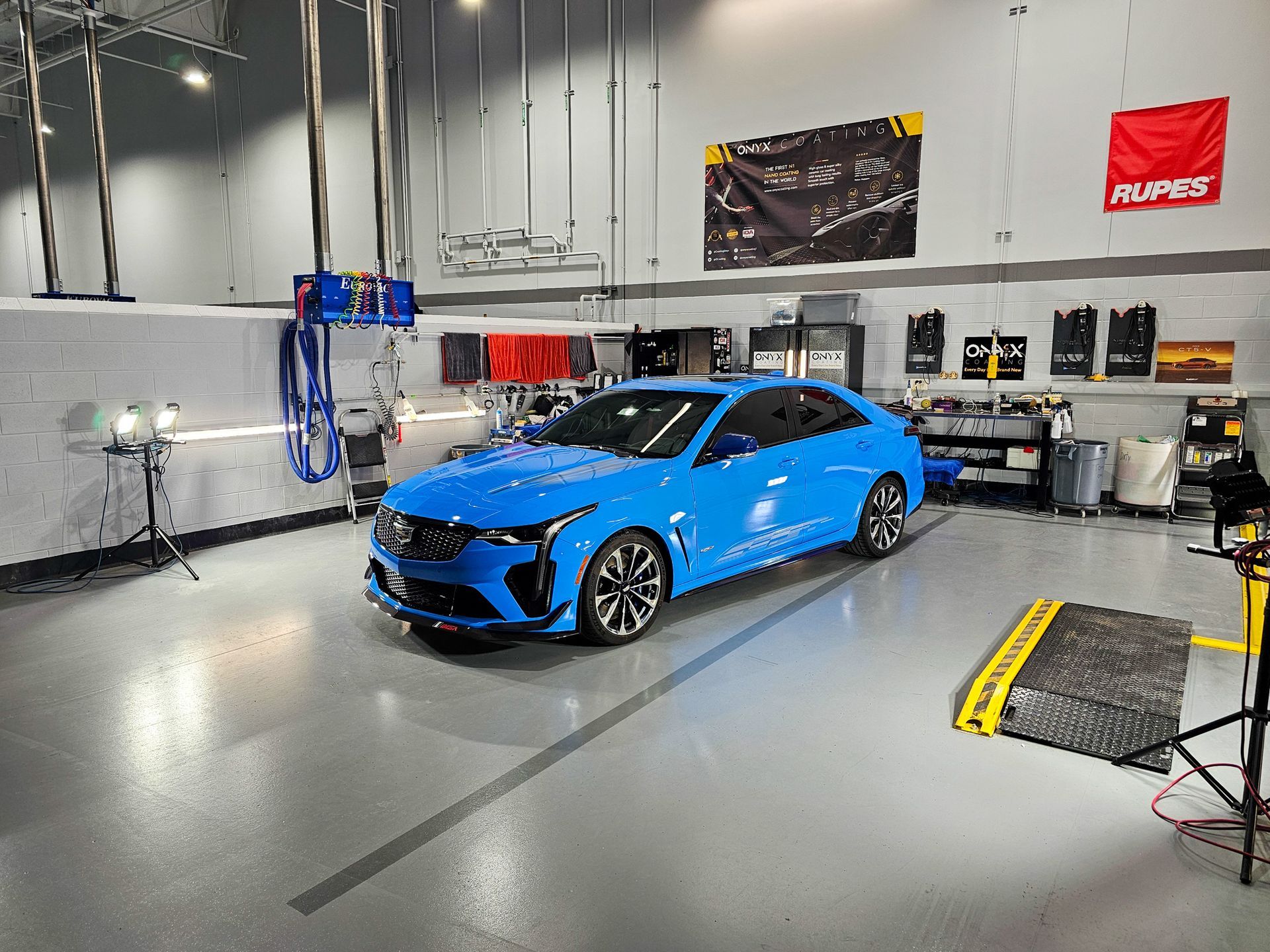
As an IDA Certified shop and Onyx Authorized Installer, we don't just apply ceramic coating; we understand its chemistry. Our technicians are trained in the science of surface preparation, chemical bonding, and proper curing protocols.
When you choose 1469 Supercenter for ceramic coating, you're getting:
- 80%+ pure SiO2 formulations with certified 10H hardness
- Proper surface preparation using chemical decontamination and paint correction to ensure perfect bonding
- Climate-controlled application that manages every environmental variable
- Lifetime warranty options backed by our confidence in the chemistry
That mirror-like finish you see on vehicles leaving our facility? That's not just aesthetics; it's molecular-level smoothness created by precision chemistry and expert application.
The Bottom Line: Chemistry You Can See and Feel
Ceramic coating represents genuine innovation in automotive protection. The chemical composition of professional-grade products (high-purity SiO2 for hardness, TiO2 nanoparticles for UV protection, refined polysiloxanes for flexibility and hydrophobic performance) creates a permanent bond that traditional waxes and sealants simply cannot match.
Understanding this chemistry helps explain why professional application delivers results that last years instead of months. It's not marketing hype; it's molecular science applied to your vehicle's protection.
Ready to experience the difference that professional-grade ceramic coating chemistry makes? Visit 1469 Supercenter in Fort Wayne or contact us to discuss which Onyx coating package best suits your vehicle and driving conditions. Because when it comes to protecting your investment, the chemistry matters.